3, 2, 1…K12 Online Underway

As we celebrate Thanksgiving Day here in Canada, I took the opportunity this evening to tune into Prof. Stephen Heppell’s opening pre-conference keynote for the K12 online conference.

From the K12 Online website…

Presentation Title “It Simply Isn’t the 20th Century Any More Is It?: So Why Would We Teach as Though It Was?”
Description: We are in the throes of a financial crisis unparalleled on our lifetimes, and at the same time in front running 21st century schools around the world learning is seeing a transformation that seemed unthinkable in the dark days of 20th century factory schools.

As we move to a new tomorrow built on mutuality, collegiality, communication, community and ingenuity can we learn anything from the colossally expensive financial collapse of Wall Street, the City of London and many of the world’s financial centres.

In three sections, and in a conversational, intimate style, Stephen examines the certainties that stare us in the face from past learning projects that clearly mapped a new world of 21st century learning; he reflects on the impact on technology on the world around us, including the financial world, and ponders on what this means for education, for learning, and for the necessary pace of change as we experience the death of education and the dawn of learning.

There’s a number of threads throughout his message, but the bit that keeps catching my attention is his ideas of “us-ness”.  He stresses that new learning in the 21st century is dependent on creating a sense of us-ness, where students can connect and be part of a community of learners.

Like last year, I have shared this conference with many colleagues.  Tomorrow, all teachers in our district are involved in a Professional Development day in their schools.  Wouldn’t it be wonderful to have each school gather staff and tune in?  Unfortunately, many schools and teachers hold tight to the concept of “sit and get” in both their classrooms and their own learning and don’t see developing and managing their own personal learning network and taking a chance on e-learning as critical to their professional development.

Stephen wraps by alluding to the death of education as being the dawn of learning.  Let’s hope.

There is still work to be done.  The next three weeks should bring more great stuff!!

tags: technology, education, whipple, learning, ,

Stop the Press…

The talk around the counter island at my house last night was our telephone company’s recent trial balloon where they suggested that the phone book might soon be a thing of the past.  Apparently, as a result of increased use of digital phone directory services – both on-line and from cell phones – and a desire to save money (and the environment??) phone companies are looking at sending printed phone books the way of the Dodo bird.

It stands to reason that with the increasingly mobile nature of our society and the ubiquitous access to information of all types (including phone numbers) people just aren’t demanding to have access to thick, heavy wads of paper anymore.

Now off the twitter chatter comes this story about the Canadian Oxford Dictionary laying off it’s entire staff.  Seems that they are citing the same shift in demand from paper to digital access as a motivation of their decision.  While they intend to continue to publish, one has to wonder just how long paper copies can be sustained.

This, of course, leads educators to the obvious question.  Just why do we continue to spend millions of dollars in printed textbooks?  They are out-of-date even before they are printed, hard on the environment, static, non-refreshable and bulky, space hogs.

I am not sure of the exact amount spent by our school / district / province on textbooks, but I am sure that it would go a long way towards sustaining a 1:1 program for every kid in grade 7-12 in our province.  Students could then access a whole range of free, authoritative web dictionaries and encyclopedias, subject-based information and all kinds of other data.  As part of preparing our kids for the connected, digital, overwhelming world in their future, they would be taught to assess all information they find using a number of strategies – REAL preparation to work, play and learn in the 21st Century.

I can live without my printed phone book, dictionary and textbooks.

tags: technology, education, whipple, learning, dictionary, phone book,

Photo Credit: Toronto Phone Book, uploaded to Flickr by Pink Moose, Creative Commons License.

100 K’s of Wikis

It wouldn’t be a surprise to anyone that my favourite web tool for learning continues to be the wiki.  From a classroom resource and communicatuon center to a platform for student-produced content and collaboration, this tool is incredibly versatile and weaves so easily into the fabric of a flat classroom.

While there are several wiki farms providing free education wikis (e.g. Wetpaint, PB Wiki), my favourite (apologies to Jeff Utecht) continues to be Wikispaces.
There are many reasons for this, four of which stand them apart from the others – the fact that they provide free, fully functional wikis for K-12 education on-request, the ease and versatility of adding student accounts, the ability to lock out certain pages and have multiple editors on same pages,  and – most importantly – the HUGE file upload space available (2 GB per space!!, limit of 20 MB for any one file). Add this to what has to be the best service I have ever experienced from any company, and it’s a winner all around.

For the past couple of years, Adam Frey and the folks at Wikispaces have been promoting the use of wikis in education by giving away 100,000 free wikis to K-12 educators.  I am happy to say that they have reached the goal – well over 300 of them would be spaces from teachers I work with!!

Received this release from Wikispaces today – they don’t plan on stopping now!

To Adam, and the gang…keep it up!

————

We just gave away our 100,000th free K-12 Wikispaces wiki! So we’re celebrating and announcing our new commitment to the education community.

Our K-12 program has been hugely rewarding for us. We have worked with hundreds of you every day, heard your stories of engaged students and excited teachers, and had the chance to meet some of you in
person. Working with you all has kept us excited about building a better Wikispaces service for you and many more teachers like you. Thank you for being part of our vibrant educational community, bringing innovative collaboration to your classroom, and giving us the feedback that has helped us improve our product along the way.

We are privileged to have served you, and we aren’t stopping here. Starting today, we are giving away 250,000 more free Plus wikis for K-12 education. As with the first 100K, our K-12 wikis come with
all the benefits of our Plus Plan – full privacy, no ads, a customizable look, our great customer service, and no usage limits.

We are also doubling our commitment to improve Wikispaces for teachers. We will be bringing you new features designed specifically to make your K-12 wikis easier to use, more productive, and more fun. And we’ll be hosting free live online events to share Wikispaces news, give short tutorials, showcase your success stories, answer your questions, and help you connect with others.

See our full announcement.

and join us in spreading the word and sharing your story.

Thank you,
Adam, Bisma, Dom, James, Jeff, Jessica, and Sarah

tags: technology, education, whipple, learning, wikispaces

Speaking of Learning

The last couple of weeks have been very busy, catching up on lots of work and stepping into the new school year. Now I am just trying to catch up on my reader, and a number of things keep popping out.

Wordle is one of them. This new tag cloud generator allows individuals to generate images that capture the essence of a piece of text, a website or a del.icio.us account. While it may seem rather silly, I believe that these new types of tools will become more important as a new information model defines the global community of the 21st century.

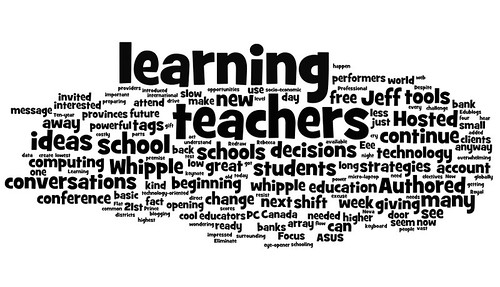
As a test, I sent my blog through the Wordle engine, and this popped out (click for a larger view). While a large smattering of terms fill the image, two primary words capture the center. The first is “learning”, reflecting my passion to shift education to reflect our young people.

The second, “teachers”, should also not be surprising. I want to point out the difference between “teachers” and “teaching”. I was happy to note that teaching didn’t even rate on the radar. This reflects a conscious effort to focus on moving the conversation from teaching to learning – to the point where I rarely discuss “teaching” strategies – or “teaching” anything else for that matter.

Now the questions becomes – could Wordle be an effective tool for learners in the education enterprise?

tags: technology, education, whipple, learning, wordle

Cool Tools…

Sometimes the array of powerful web tools available for schools is overwhelming, with more being added every day.  Part of my job is to track new tools and act as a filter, introducing them to teachers and students as learning needs dictate, but even I find it difficult to keep up.
Now, from the twitterverse (one of those tools), comes Cool Tools for Schools, a wiki (another of those tools), where the vast array is cataloged into a relatively easy-to-use reference for educators.  It seems to have all the biggies, and has introduced me to a few of the more obscure options out there.

What’s you favorite cool tool for school?

tags: technology, education, whipple, learning

The power of free…

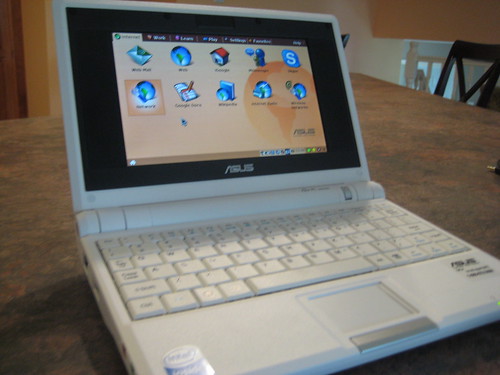
In his documentary “Bowling for Columbine”, Michael Moore visited a bank where clients received a gun for opening an account. Today a courier brought me my free gift from my bank for opening an account, something far more powerful – a micro-laptop.

The Royal Bank here in Canada is offering new and existing clients who have certain types of accounts and direct deposit their paychecks into that account a free ASUS Eee PC computer. What is the message here?

One of the messages I am giving to educators today is that the cost of computing is heading towards $0, while the power of computing is going through the roof. With cellular providers giving phones away, ISP’s giving away desktops and now banks jumping on the bandwagon, just how long can our school systems continue to cry poor.

The world is flatter and access is becoming less and less costly. As phone, television and computing services continue to converge, just how long can we continue to support industrial age schooling.

Back to my new Eee PC, it’s kind of cool. The keyboard is small and takes a bit of getting use to, but it is small and lightweight (great for travelling), the opensource OS is easy to navigate and the applications (Firefox, Openoffice, etc.) provide me with a great basic basic interface to the world. In fact, this post is typed on my new – and free – laptop.

If banks can give these away, what excuse do our schools have?

tags: technology, education, whipple, learning, ASUS, EeePC

Change…on the Fly…

Brenda MacIsaac’s session this morning at CONTACT on the shifting nature of our kids and the increasing disconnect between schools and their learning needs was wonderful.  She presented a great snapshot of the research and personal anecdotes, painting a picture of today’s youth that captured just how important it is that teachers recognize how kids have changed and the need to adapt to this change in clientele.
I am pleasantly suprised by the quality of the conversations here.  It’s a very different feel than other events I have attended that were not tech-specific and the story emerging is one of teachers seeing the need and demanding opportunities and change within their school.  In fact, the quality of the conversation here is at a level approaching that of some of the major “ed-tech” conferences I have attended.

Tomorrow I am presenting a workshop on School 2.0; Creating Flat Classrooms for the 21st Century.  I now am reviewing my session on the fly, adapting stuff she covered and building upon conversations she started.

For a small, “non-tech” conference, Brenda and a few others have a chance to start real conversations about changing the narrative of learning and how we can use technology to connect to students and have them connect with each other.  This is turning into a pretty “shifty” event.

tags: technology, education, whipple, learning, contact2008

From Hopscotch to Hypermedia (live blogging)

Live blogging morning session at CONTACT2008 conference.  Please excuse typos and grammar.

“From Hopscotch to Hypermedia: A Vision of K-12 Students Today: Growing up Digital” – Brenda MacIsaac, NSTU

———–

This is not a workshop on technology, this is a workshop on students and learning.

Technology transformed my practice, I couldn’t teach like I did before.

Have our students changed?  How are they different?

Starting with the new version of Karl Fisch’s original “Did You Know” …icebreaker first…teachers fill in the blanks of some of the facts in the presentation.

Is there a disconnect between schools and clients they serve?  What our kids do outside of school is embraced by the millenials.  Digital Natives have changed radically.  Computers are the oxygen for todays’ kids.  There is a huge digital discinnect between schools and students.

Are these digital natives different because of digital media?   Research shows characteristics of today’s students…assertive, determined, curious, close bonds, independent…emotional and intellectual openness, hopeful/optimistic, accepting, extremely social

Breaktime…

Do they learn or approach things differently? Do they think differently? Reserach shows student are innovative, achievement oriented, immediate, like structure, discovery, self-reliant, prefer intercatives, hugely collaborative, can multi-task and multi-preocess and they want relevancy!! They are primarily visual-kinesthetic learners. Need to use graphic organizers, pictures to reinforce learning.

Kids want to learn things.  Ref: “A Private Universe” (search Youtube video)…once kids get ideas in their minds it is hard to unlearn things…difficult.

Brain Plasticity: What is It?  Brain responds and develops according to stimulus.  Physical changes will result when different ideas are introduced.

Group discussion of Marc Prensky article “Turning on the Light”.  Interesting discussions…some get it!

It’s their after-school education that is preparing them for their future more than their in-school education.

Classrooms must be interactive and experiential, creative learning, higher order, collaborative spaces.  Students should not be doing the same assignments and activities as everyone else.  Break down classroom walls…

It’s not about whether we are DN’s…but can we adapt for our students.  We need to erase our own “memories” about learning.

Change is inevitable.  Growth is optional.

tags: technology, education, whipple, learning, contact2008

“Off the Grid” in the Big Easy

Last Tuesday evening I said goodbye to many old and new friends in downtown Memphis at the closing party of yet another great Laptop Institute conference hosted by the wonderful folks at Lausanne Collegiate School (more thoughts on that later). After a couple hours of sleep my wife and I caught “The City of New Orleans”, made famous by the Arlo Guthrie ballad of the same name, and thoroughly enjoyed a pleasant and very economical seven hour journey down the river to New Orleans. I must give kudos to the folks at AMTRAK for their service. I hope that as flying continues to become more of a hassle, train travel will experience a resurgence across North America.

This was my first experience in New Orleans and didn’t really know what to expect. After three years of Beale Street in Memphis, I figured much of the same except with a jazz feel. To say that New Orleans didn’t match that expectation is an understatement.

Despite being ravaged by Katrina just a few years ago, my experience in New Orleans was amazing. In fact, expect for a couple of derelict buildings that were pointed out by tour guides (which could have been the result of any variety of reasons) there was no evidence of the destruction visible in the downtown area. I will admit that we deliberately avoided the Katrina Tours available (we wanted to return home with good memories), but Katrina certainly was not on prominent display.

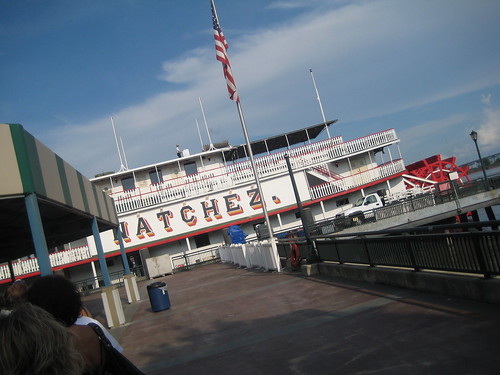
New Orleans was nothing short of amazing. From the dinner cruise on the Natchez and the Swamp Tour put on by the wonderful folks at Westwego Adventures to the romance of the French Quarter and the freak show of Bourbon Street, this is a city like no other.

The other part of New Orleans that was refreshing was to be disconnected for five days. In his keynote at LI, Scott Klososky spoke of the need to get “off the grid” to refresh. Well, I took his advice and for five days there was no blogging, twittering, emailing or even checking the weather online. I was completely disconnected from the web, and it was good (I think my wife enjoyed it too!!).

More on my thoughts on another great Laptop Institute later.

tags: technology, education, whipple, learning, laptopinstitute, scott klososky, new orleans

Live Blogging – afternoon Keynote – Gary Stager

live blogging

Gary Stager – Ten Things you can do with a Laptop

Laptop Institute – Memphis, TN

———–

Intro by Susan Einhorn, AALF…Gary is abrasive, annoying, challenging…but passionate about learning

Gary…

Online handouts… http://www.stager.org/memphis/

Question…what is the world like for kids who haven’t even entered school…

We spend a lot of time on PowerPoint…why are we spending a lot of time training kids to be used car salesman…

Software determines what you do and what you do determines what you learn…

ideas…

1. Write a novel – authentic work valued by other people…kids can write more, better, differently, fan fiction…different media, podcasting, fiction / non-fiction..create…if the reason for having a computer is to look stuff up, why are we surprised when they look up inappropriate stuff

2. Share your knowledge – changing nature of memory…authentic audience…passion = accuracy

3. Answer Tough Questions….”Who Should I Vote For?” – a webquest alternative ( http://www.stager.org/whoshouldivotefor )…kids will go a lot further than we think…use primary sources…

4. Make sense of data…google Earth, GIS software, Inspire data, tinkerplots, etc…

5. Design a video game …instead of consuming them, kids can design them…games are not necessarily a great learning tool…but as designers kids are learning about math and design…

6. Build a Killer Robot – esp. great for Math/Science…tactile, outside of computer, testing, debugging…

good prompt, appropriate materials, supportive culture and sufficient time  = ability to solve problems

7. Lose Weight – “Less Us, More Them”…always ask…how do we make the experience richer for kids as opposed to easier for us…

8. Direct a blockbuster –  Two rules needed for every classroom…video should be shorter and should be edited one more time….mirrors the writing process, different genres (science experiments)

9. Compose a symphony…finalnotepad.com or apple.com/garageband…multimedia studio inside…EVERY kid can be enriched…not just those with access to expensive studio…(e.g. http://www.missyhiggins.com kid started creative in early laptop school)

10. Change the world…move beyond the computer as a prop…create change…engage in the global community

Imagine an educational system that had a grad requirement that you had to answer a question…

Technology Matters…extends the learning opportunities…

tags: technology, education, whipple, learning, laptopinstitute, gary stager