Memories from the Beginning…

I love my job – I often say I have the best job in the district – and am excited about coming to work everyday, but I am particularily excited about today.

It was September of 2002 and, having quit my public sector job a year previous to return to school for a BEd – I was only a couple of weeks into my new career as a teacher.  I certainly was motivated and thought I was ready, but nothing quite prepares you for the challenges of the classroom – even teaching as a student intern – especially when the “classroom” you were thrust into included three teachers, all 64 Grade 6-8 students in one large, open space! Frankly, I was terrified, confused and overwhelmed.  Nothing in my teacher training even hinted that these types of classrooms existed, let alone that I might be teaching in one at Keswick Ridge School my first year out.

But I was lucky.  I was paired up with two wonderful teachers. Mrs. Green was young, vivacious, spontaneous and a riot.  She taught Language Arts and Social Studies with passion and enthusiasm, wearing her heart on her sleeve.  Mr. Wilton, on the other hand, was more traditional in his approach.  He taught Phys Ed, Health and Science, and was quite content driven.  I was given Math and Technology as my assignment, but to say that we were limited to these subject areas would be painting a false picture.

In reality, we all were involved in pretty much everything.  We were all in the classroom together, a true community of learners, circulating and working with students all the time.  On top of that, we were supported by a wonderful and visionary leader in Principal Barb Corbett.   In retrospect, I couldn’t have asked for any better way to start my career.

I often hear from teachers – and have been subject to it myself – that isolation is a huge barrier to learning for teaching professionals.  We get sequestered in our own classrooms, tied up by our own needs and challenges and don’t get to learn from each other.  Instead, I was able to not only watch other people teach – with very different styles – but was able to receive their support and constructive criticism in my teaching. They both taught me a lot and supported me – a huge plus for a first-year teacher.

Not only that, but the structure of this K-8 school, with multi-age/multi-grade classrooms in K-2 and the 6-8 Middle School forced me to think outside the box.  The first month was a stunner, then one day it was like a light-bulb went on…WOW!  This wasn’t teaching, it was learning!

I only spent one year at KRS before, tearfully, I was transferred (due to dropping enrollements) to a large, urban middle school where I almost died teaching five Grade 8 Science classes a day my first year there.  It did get better as I was fortunate enough to play a leading role in transforming my school into a leading 1:1 laptop program my second year there, but I have yet to see – and I have been fortunate to visit a lot of schools the last couple of year – a learning environment like “The Ridge”.

However, good things come around.  Today I am spending a full day back at Keswick Ridge.  I hadn’t been to the school since I left five years ago but I am so excited that I will be spending some time here this year.  My supervisor, knowing that my 1:1 school was maturing enough to share me around, offered me an opportunity to take on two new schools, including KRS.  Walking in here this morning – the beautiful Mrs. Green is the only one of the three of us left here – was amazing.  She is an incredible teacher and friend and I am excited about being able to spend time here promoting 21st century learning through collaboration and project-based learning.

It’s great to be back.   Mrs. Green…let’s have some fun like the old days!

tags: technology, education, whipple, learning, keswickridge

Switching it Up

A couple of weeks ago I was in my car listening to a program on CBC Radio One – I believe it was “As It Happens” – and they were talking to two high school chemistry teachers in Colorado who were looking at creating more time for hand-on activities and one on one time for students in their classroom by pre-recording their “lectures” and providing them to students to listen to in the evening prior to class, preparing them for the “work” portion of the learning during class time.  In essense, they were reversing the lecture/homework paradigm to have students intake at home and do “homework” at school.

I was immediately caught by the idea, but as I was in my car I didn’t have any means to record the information for further reference.  Fortunately – and I should have anticipated this – Karl Fisch picked this up and fills us in on some of the details.  Apparently, one of his teachers had also run across the two innovative fellows – I now know their names as Jonathan Bergmann and Aaron Sams, who teach high school chemistry in Woodland Park, Colorado.  They have established a website, Educational Vodcasting, which will help teachers and others learn more about the practice.

This is something that a couple of teachers have also asked me about, but we have not progressed past the stage of conversations about the possibilities. Armed with their website and a few other links,  I am sure several teachers on staff will be interested.

There really isn’t any reason why this couldn’t work.  Screen-casting a “lecture” can easily be done using the record feature in the SMART Notebook software (or any number of other tools), and the videos can easily be uploaded/hosted/managed in a wikispace.  Wikispaces will allow a single file size of 20 MB, which would translate into roughly a 8-10 minute video.  Longer segments would simply be snipped into two or more parts.

Or, better yet, Brian Hatak, the teacher at Arapahoe HS where Karl works, has started his trial.  His “lessons” are posted on Teacher Tube –  a moderated, education friendly version of You Tube. A sample is below.

What issues arise with this?  Some teachers have raised concerns about their personal privacy but as teachers, aren’t we all public figures in some way?

Part of developing professional learning communities is about breaking down the isolation and supporting teachers sharing.  This is certainly promoting teachers learning best practices from each other.  Talk about breaking down the walls!

tags: technology, education, whipple, learning

The Next 5000 days

From the twitterverse, courtesy of @JoMcLeay, comes this offering from Kevin Kelly. In another offering from the TED Talks series, Kevin Kelly notes that the web is only 5000 days old, and ponders what the next 5000 days might bring. His ideas are challenging, but offer great opportunities for the global community

He postulates that the web will change dramatically – with transparency being the price of development. We might even begin to think about this as a large organism that we will begin to interact with – a difficult concept – where there is only the one machine (us) and it is the web.

What might this mean for education and learning? How will this impact on how we learn as individuals and as a community? Where might this take us as educators?  Can teachers simply continue to yearn for the “goold old days”, resisting the demands of the information revolution, lamenting the way their students have “lost their interpersonal skills” – while failing to realize that this generation is more connected, more “personal”, than any generation in history.

Stay tuned for the next 5000 days.

tags: technology, education, whipple, learning, kevin kelly

The end…or a start?

I am sitting in the closing keynote of CONTACT, a joint conference of teachers from the four atlantic provinces in Canada, listening to Betty-Jean Aucoin.

This is NOT a technology-oriented conference, kind of a change for me.  I wasn’t sure what to expect coming in, knowing that I was invited to speak on “Creating Flat Classrooms for the 21st Century”.  Would delegates be interested in the shift?  Would they resist? Where would the conversations flow?

Right off the bat, I was impressed with the quality of the ideas.  Quite a few teachers engaged in the conversations about the future of learning at a higher level.  They got it.  Others were interested and eager to learn more. Other pushed back, an important role to make those of us who tend to charge ahead challenge our ideas.

I think the biggest takeaway from this event for me, however, is that teachers seem ready for change.  They are beginning to see that change is needed and seem ready to start the shift – at least as a collective.  The conversations I have had here with classroom teachers have been valuable.  It was an eye-opener to see what our next door neighbors in Nova Scotia, Prince Edward Island and Newfoundland faced each day.  Despite the opportunities to attend international conferences and connect with teachers globally through blogging and twitter, I was not all that connected to the people right next door.

I feel for them.  Ten-year old computers, slow connections and filters that block blogs.  Change will happen, but it will be slow.  Too many bureaucrats make too many decisions about learning that they don’t understand and those decisions do nothing to prepare our students for their future.  In fact, many of the decisions create barriers.  I can’t tell you how many times last night I was told by teachers from the other provinces that their departmental decision-makes needed to hear the message of 21st century learning.

As this conference wraps up, we see it as the end. What I am hoping is that it is only the beginning – the beginning of conversations in our region of the country to continue the shift in learning.

tags: technology, education, whipple, learning, contact2008

CONTACTing on the East Coast…

My wife and I enjoyed a leisurely drive yesterday, turning what would normally be a five hour drive into a ten hour tour as we drove along Nova Scotia’s Eastern Shore on my way to the CONTACT conference at St. Francis Xavier University in Nova Scotia.

Taking in a winery tour at the Jost Vineyards and fish n’ chips at the world famous Murphy‘s in historic Pictou, we truly enjoyed our day.

Last night was opening keynote for CONTACT – an education conference hosted by the teacher’s federations of the four Atlantic Provinces (Newfoundland, Prince Edwards Island, Nova Scotia and New Brunswick).  As always, the conversations are the best part, but last night’s keynote was simply amazing!  Charles MacDonald was hilarious, poignant and challenging, brining with him a message highlighting the increasingly important role of educators to the lives of our young people.

“I’m gonna talk, and you’re gonna listen.  If you happen to finish ahead of me just raise your hand.”

Charlie drew on his background as an educator of over 35 years to spin a powerful narrative on the value of relationship.  The basis for connecting in all relationships – including with your students – is forming a relationship.  Kids form an impression in minutes.  It’s different than in the past where teachers had respect by virtue of their position, now educators have to work hard to earn everything from kids – including respect.

Definition of expert: x = unknow quantity in Math; “spurt” = drip under pressure

Add to the 3 R’s one more…presentation skills.  Life is a bunch of presentations.  When you get up in the morning you begin presenting yourself; to your wife, kids, colleagues, etc.  We need to give young people these skills.

We have eliminated a whole bunch of caring adults from the lives of kids (storekeepers, community, neighbors, etc.)  Teachers are what is left in many cases – so this makes our role increasingly challenging.

**********

This was one of the most dynamic presentations I have seen in quite some time.  Just one man, sharing stories w/o props or pictures in the grand tradition of learning through stories.  Quite a moving experience.

Day 2 starts now!

tags: technology, education, whipple, learning, contact2008

Where will the change come from?

After enjoying the better part of a week being off the grid, I was working my way through my feedreader this evening, catching up on my network.

One item that caught my eye, mainly because it is something that I have been pondering about for the past week or so, is a post by Jeff Utecht about a conversation he had with his wife.  She postulated that that change in education – real change – will only happen with another Sputnik.  Her analogy was that until the US (and by extension us here in Canada as well) are shocked, scared or otherwise threatened by a perceived threat from outside, there won’t be any real change in the way we teach.

For the past week I have been thinking a lot about Scott Klososky’s keynote at the Laptop Institute conference in Memphis last week.  Scott drew a parallel between Apple’s moving into the void created by the disinterest in change by the traditional music industry to become the major music distributor in the world.  It took a computer company, not a music company, to see the possibilities.

Scott mused that maybe it’ll take the same kind of model to shift the education system.  Maybe as the tradional schools with their industrial model of teaching continue to miss the boat on the shifting nature of the world and, more importantly, our kids, some other entity will move to create a new learning model that will serve these 21st century learners.  It might be someone like Apple or maybe a model like Curriki where the community takes ownership of the learning enterprise.

I am not sure where the change will come from…or when it will come.  One thing is for certain, the tradional model of school, particularly in North America, will become less and less relevant to our youth and their lives as connected global citizens.  While I tend to think the change will come from an entity from within and not a Sputnik from abroad, it will happen.

Are we ready?

tags: technology, education, whipple, learning, scott klososky

“The World is Flat” Audiobook Giveaway

One of the great things about summer is that teachers have the time and the opportunity to become active learners by catching up on reading.  Unfortunately, all too often, teachers don’t see themselves as learners…but that is not what this post is about.

Every teacher who cares about understanding the world we are preparing our kids for should try and understand the little we do know about the future.  After all, how do we begin to prepare students to be active and productive 21st century global citizens if we don’t care to know about the new global community ourselves?

There are two books (neither of them specifically about education) that I encourage teachers to read. The first is A Whole New Mind by Daniel Pink, the second is Thomas Friedman’s landmark The World is Flat.

In his work, Friedman documents the shifting nature of the global economic, cultural and political communities, pointing to ten “flatteners” that have helped create a flat world where geography is becoming less and less a factor in participation in a global, connected community.
Now comes word that consumers can have access to TWIF for free…in audio form.  According to his website, readers (listeners?) can begin to receive audio downloads from the book beginning July 25th.  In addition, we can also receive excerpts from hiss new book Hot, Flat and Crowded.

With such a reluctance by teachers to read for learning – sound familiar? – maybe they would be more open to listening instead?  Let’s hope.  I’ve signed up!

tags: technology, education, whipple, learning, theworldisflat, thomas friedman

Into the frying pan…

It’s been particularly warm here on the east coast of Canada, one of the two or three weeks during each summer when the temperatures and humidity get together and run the outdoor humidex scales upwards of 40C.  The temps usually break quick, but this year the heat will be extended for me and 9 other staff of Nashwaaksis Middle School as we leave Friday for Laptop Institute in Memphis, Tennessee, where this weather is normal fare for the summer.

This will be my third trip to Lausanne Collegiate School’s wonderful 1:1 gathering, an event that has played a huge role in the fundamental shift of my own personal vision of learning.  I am looking forward to returning and, with four presentations/workshops scheduled, providing some ideas for others to chew and grow on.

I am busy this week getting the presos ready.  The first offering on Monday morning will be a two hour workshop entitled “Ten (not-so) Secrets About Wikis“, where we’ll spend some time exploring not just the mechanics of building spaces, but also looking at some examples of effective uses of wikis and how they can play a role in shifting learning, especially as student content platforms.

After a general one hour session on Web 2.0 Tools in the classroom (many teachers are still unfamiliar with the term, let alone the variety of tools available) on Monday afternoon, I’ll be leading another workshop on “Learning to Blog, Blogging to Learn” Tuesday morning.  I intend to focus on not just blogs, but a couple of other conversational tools (e.g. twitter) and how they can be used within the classroom and as a means of developing a Personal Learning Network.  On Tuesday afternoon, it’ll be a one-hour presentation on RSS and it’s powerful application as web content filter.

This is a great event.  The folks at Lausanne are generous and well-organized, the keynotes are first class (I am very excited about seeing Gary Stager for the first time and chatting with Denise Frazier-Bowen again) and the more intimate nature of the gathering really promotes teacher connection and collaboration.

I am particularly excited about having nine members of our staff attending this year.  It’s an investment in ideas, vision and leadership that I believe will have a huge impact in moving our 1:1 program into the future.

tags: technology, education, whipple, learning, laptopinstitute, wiki

Special thank-you’s mean so much…

I dropped by my boss’ office last week for a chat.  It was the end of the year and, while we keep in touch pretty much daily on twitter, it’s always good to have that f2f interaction.  We always seem to share ideas and frustrations, sharing our visions of learning.

As I sat down, I noticed a few laptops sitting in a carrying crate.  Our district has put together a few “loaner kits” of laptop pods for K-5 schools.  We also have loaners of GPS units for geocaching and podcast equipment.  While not the ideal of having ubiquotous access for all learners, it is a great start.  The units are in constant demand – a good problem to have – and the district continues to work to have more mobile kits available.

My boss was telling me about a recent visit he made to a Kindergarten class.  This young boy was eager to talk.  “Hey mister!  I wanna show you something…come over here!”.  My boss, of course, wanted to see what the youngster had created.  But it wasn’t a product that he wanted to show.  It was a secret.  The secret of the red line.

“See what happens when I don’t spell a word right”, he said.  “This little red line appears underneath it.  And look, if I right click, I get this word list and I have to choose the correct spelling for the word I want”.  My boss, of course, played along, pretending to have seen spellchecker for the very first time.

I know that many – including teachers I talk to – don’t like spellcheck.  They think it excuses kids from learning to spell.  I would argue that it does just the opposite.  If the red line didn’t appear under the word, he would never have known it was misspelled, and would never have had the opportunity to correct his spelling.

This child was becoming a 21st century learner.  Utilizing the available tools, he was able to identify and solve a problem.  This type of assistive technology will be increasingly available in their work, play and learning spaces.

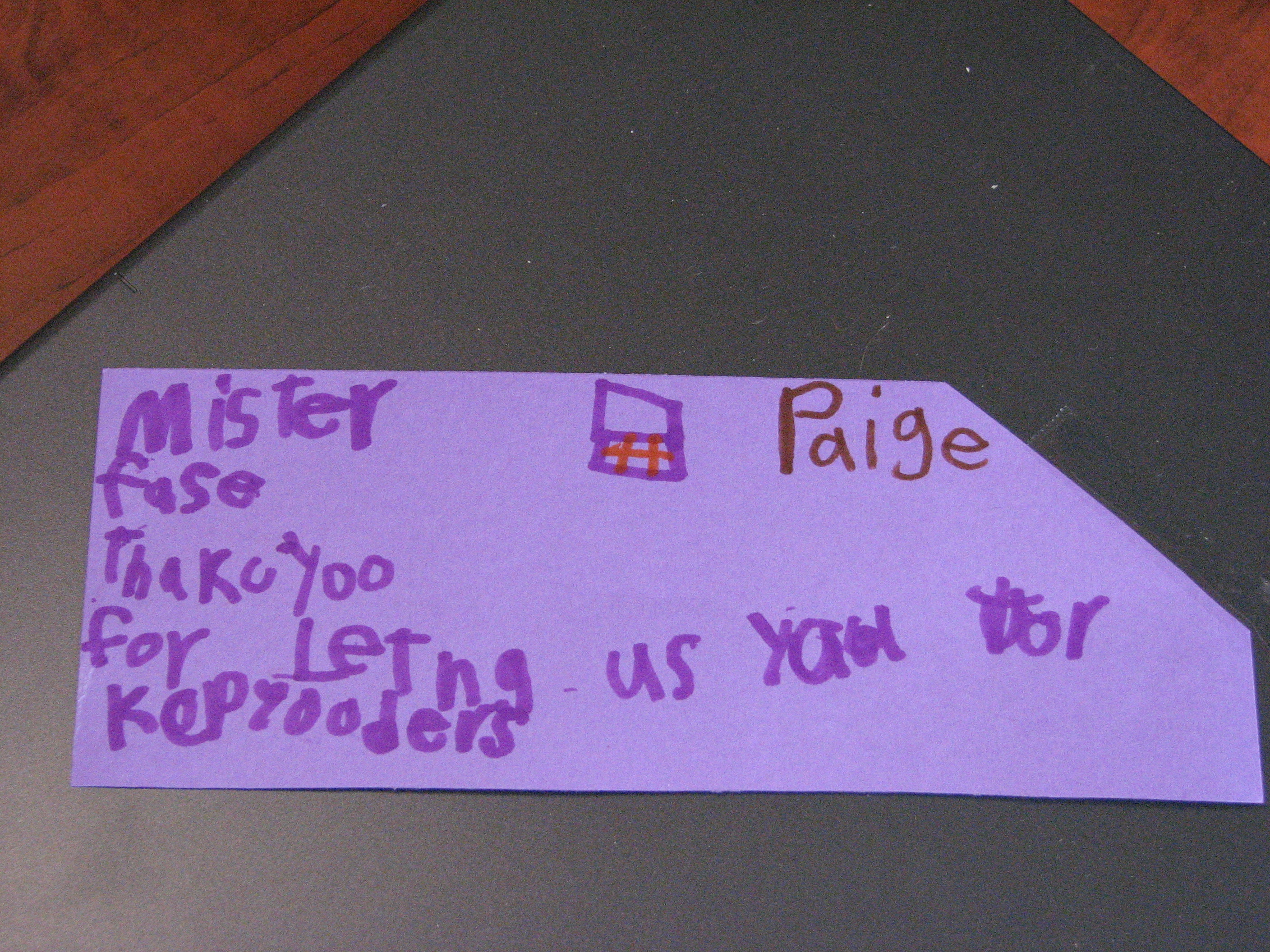
Of course, no loan would be complete without the thank-you note.  Coming from a kindergarten class, you would expect nothing less than perfection, misspellings and all!

Paige writes…“Mister Facey, Thank you for lending us your computers.”

What more could you ask for. Perfect.

tags: technology, education, whipple, learning

Can we go home again?

I was fortunate to grow up in a region more beautiful than any place I have ever visited (and I have been fortunate to travel a fair amount).  The Miramichi River region of northeastern New Brunswick in Canada is a generally rural area settled by the earliest European settlers to North America.  The strong Irish flavour of the area is evident in the English-dialect spoken by many of the people.  While I have generally lost the slang, it quickly comes back as soon as I cross the watershed line.  “How’s she goin’ by?”

Dependent on a natural resource based economy – particularly pulp and paper / forest products – the once booming area has struggled as of late, the victim of  increasing competition from cheaper producers in the developing world.  With highly developed transportation systems, the primary consumers from the US east coast simply find it more economical to source paper products from overseas.

I am home “on the river” this weekend.  My son is playing in a baseball tournament that has brought me home.  Simply put, a hectic lifestyle doesn’t give me enough opportunity to visit family here.  Friends aren’t much of a pull, as most of my high school chums have moved away to find opportunity.

Those that have stayed are mostly tradespeople,  doing the latest in a long-distance commute after the closing of the areas five mills, working in employee-hungry Alberta for 3 weeks and returning home for a week.  It’s certainly not the ideal – long times away from family are hard at both ends – but a choice most people live with in order to remain at home in the hopes that a miracle will happen and bring jobs back home.

Every time I come home –  and it will always be home – I have this urge to return permanently.  This time is no exception.  The river has this strange pull, even though there is little here economically.  I have a hard time placing my finger on it – maybe it’s the genuine nature of the people, maybe it’s the natural beauty of the area, maybe it’s the memories of salmon fishing as a youngster with my dad, maybe it’s the sense of community or maybe it’s a bit of all of that – but there is just something very special about the Miramichi.

Having said that, I am also excited about the opportunities to live globally.  My wife and I have been exploring discussions about taking a leave and spending some time living and working in Asia in the near future.  Is there a clash with these two tugs on the heart?

As educators, what does this flexibility in terms of opportunity mean for our students?  How many of them will be able to stay “at home”?  How many of them will choose to?  With the connected global community, how should the story of learning change to prepare our young people to work, play and learn in the world of the 21st century?

One thing is for certain, wherever I may live or visit – and I have now lived away from the river for over 20 years – the “Meer-ma-shee” will always be home.

tags: technology, education, whipple, miramichi, learning

Photo Credit: Rushhour Water Street, uploaded to Flickr on September 4, 2006 by tanker625