Seven Things You Didn’t Want to Know

Thanks – I think – to my friend Page Lennig for tagging me in the seven things meme.  The idea is you get tagged, you share seven things people are unlikely to know about you, and then you tag others to share their secrets.

So…here goes!

  1. I am an international fastpitch softball official – and have traveled around the globe to work three world championships.
  2. My favorite place in the whole world is Matthew’s Head in Fundy National Park (see photo).
  3. I was once on a flight between Dublin and London and sat just behind Bono of U2.  He’s quite short.
  4. I have undergraduate degrees in Geological Engineering and Education.  I came to teaching at the ripe old age of 39!
  5. My family is half a Brady Bunch – my wife and I have each contributed two kids to the mix.
  6. Nobody should ever confuse me with a mechanic or a handyman!
  7. I used to manage a public radio station, and did some summer DJing at my hometown station.

Hmmm.  Now, who to tag?  How about…

Sharing Our Story

I have been aware of the Anywhere, Anytime Learning Foundation (AALF) for a couple of years and have followed their work from the periphery.  The AALF is a non-profit organization dedicated to promoting access to learning by children around the world through access to 1:1 computing and other technology-rich programs.

This month’s issue of their regular on-line publication is special for teachers at our school.  Last fall I was asked to provide an article, focusing on how curriculum has changed since the introduction of our 1:1 program five year ago.  It was a pleasure to be able to showcase the work of our talented and dedicated staff.  You can read the full article here.

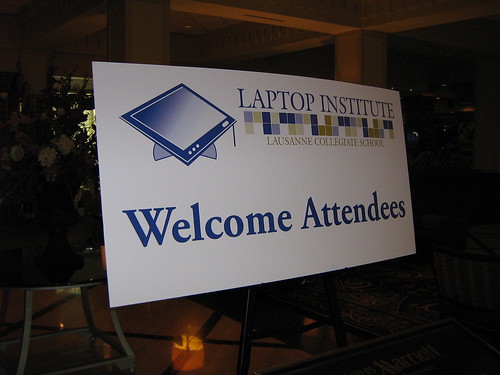
This summer, 14 of our staff will be representing the great work of their colleagues as we share our collective story as the 2009 Spotlight School at the Lausanne Laptop Institute in Memphis.  If you are a laptop school, thinking about a laptop program or even looking at ways to leverage technology-rich environments for learning, I would love for you to join us in July.  The AALF co-sponsors this event with the host Lausanne Collegiate School.

Click on the badge in the top right of this blog for details on the conference. Hope to see you there.

Technorati tags: technology, education, whipple, learning, laptopinstitute, aalf

Unexpected observations

Last week was exam week at our local high schools.  As the father of a Grade 10 student – and having had three kids pass through high school already – I have had conflicting feelings about summative testing.  I wanted my kids to do well for self-esteem and future opportunities, but have always felt, even prior to becoming a teacher, that exams were less than an authentic measure of a person’s knowledge and thus have tried to downplay any expectations of what it meant to be successful.

As I picked up my son last week after his last of five exams for the first term, my ideas about these rituals began to crystallize.  Piling into the car, I asked him how his exam went.  His response – as usual – “OK”.

After a brief pause he asked rhetorically;

“Why do we write exams?  They are kind of like cheating.  They don’t measure what we know. They give us all this information, we memorize it, we write it on the paper and then forget it.  We don’t really learn anything.”

Whoa!  The kids even see how false is their supposed “learning”.  I was blown away by the simplicity of his insights, shared by his friend in the back seat.

So, if we can agree that simple content recall isn’t a measure of anything but how well a student has learned to “play school”, what is the answer?

I would argue that exams don’t need to be eradicated, just modified.  Instead of closed-book, content focused assessments where students simply regurgitate answers fed to them by a teacher over the course of several weeks, why not focus on the process.  Exams could look different, like real-life.

My supervisor has recounted how he gave an “exam” once where he gave one question; design and create a solution to a problem.  All information was available, the issue was authentic and the solution might not even be limited to course content.  Wouldn’t this be a better measure of student learning?

For now, my son has helped my learning process.  You see, it’s in the (sometimes brief) conversations where real learning takes place.

How would / could our exams look different five years from now?

Technorati tags: technology, education, whipple, learning

Photo Credit: Setting The Tone For the Exam; Uploaded to Flickr on June 8, 2006 by rileyroxx

What’s in a name?

Last week I was reviewing the user accounts for an online educational service to which our school subscribes.  I was reviewing the accounts to archive former teachers and see which of our new teachers were using the service. As school administrator for the service, I also have access to usernames, which are generated by the teachers themselves.  It is really amazing how much you can tell about people by what they choose for their username. While most had some version of their real name, some had “innovative” – even bordering on graphic – login ID’s.

What’s amazing is that teachers who are signing up for an educational service provided by an external company would use such handles for their username. It reminds me of the various email addresses provided by adult students in the undergrad Education course I taught the last two years at the local university.  Many contained strong imagery – with various takes on “sexy” thrown in – and were far from professional.  I didn’t say anything to any of them, but thinking back, I think I failed them somewhat by not having the conversation about professionalism and digital citizenship.

The question is, if these adults are the ones teaching (or preparing to teach) our students, just what do they have to offer in preparing our future digital citizens.  This is something we need to have conversations around in our schools, but who is going to steer the ship towards sound ideas surrounding creating a positive digital footprint?

Unfortunately, I didn’t have access to their passwords.  I wonder what stories they may have told.  On second thought, maybe I don’t want to know.

Technorati tags: technology, education, whipple, learning

Photo Credit: Timelog Login, Uploaded to Flickr on July 9, 2008 by freddyware

The 21st Century Interactive Poster?

Frankly, I shudder when my son asks the question…”Hey dad, can you get me some bristol board?”.  Another poster on the way.

In all my years working in the fields of Engineering, media and project management, I never used or benefited from the having a poster to communicate information.  In schools, they usually are little more than busy work designed to keep students (and parents!) pacified with a basic element in the traditional narrative of education.

Lately, we have seen educators introducing technology to digitize the process as students created collages of images and text digitally.  While this could conceivably be of some benefit in teaching basic computer skills and the efficiencies of digitizing previous practice, it still limits students abilities to collaborate and share their work with an authentic audience.

I recently was introduced to Glogster through twitter (I only wish I could remember who!).  This web-based tool provides an opportunity for students to create and share digital “posters” which they create themselves, either as individuals or in collaborative groups.  These products can include not just text and images, but also hyperlinks and audio.  They can be made to be highly interactive and can be shared via email, through the glogster site itself or embedded into blogs or wikis.

Below is a quick example of a “poster” that I created in just a few minutes.  There are hundreds of much more interesting examples on the site.

I see many uses for this in classrooms as students connect and communicate their new knowledge to an authentic global audience.  From poetry and music to equations and earth science, students could make wonderful media collages.

Check out this collection of Animal Glogs from an elementary school.

What kinds of opportunities to you see?

Technorati tags: technology, education, whipple, learning, glogster

How do we interrupt the story?

Being in a small capital city where government and universities are the two major economic drivers has it’s benefits.  Having two undergraduate education programs in town, combined with two other programs less than 90 minutes away, provides us with many opportunities to host student teachers / interns at our school. This gives us a chance to gauge how different programs are preparing students as educators in the 21st century.

One program in particular has really taken a lead in starting conversations about the shift from teaching to learning and the role that technology and the web must play in providing opportunities for students to connect and collaborate. The others? Well…there is still work to be done.

Today I had an opportunity to spend some time with a new student who just started a 12 week internship at our school.  The conversation started somewhere like this.

******

Me: So, what kinds of courses have you had surrounding technology in your education program?

Her: None

Me: You haven’t had any courses where you used technology?

Her: Well, they did tell us about SMART Boards, but they never taught us how to use them.

Me: Have you heard the term “Web 2.0”?

Her: No

Me: Are you familiar with blogs, wikis?

Her: No

Me: podcasts?

Her: I’ve heard of podcasts, but not in my courses.

******

Now, this was just a small part of the conversation, but pretty reflective of where she is starting her career. I spent the next hour updating her on our 1:1 program, how we leverage technology for learning, some of the projects we do.  I think I scared/stunned her, especially when I told her that we actually have teachers who have used Social Networking tools like Facebook for learning. I still have much to share.  My question, just what has she learned by spending 3 terms in an education program that has prepared her to be a learning leader for the 21st Century?

It reminded me of Greg Whitby’s video where he encourages us to change the fundamental DNA of teaching and learning.

What role do our university/college teacher training programs have to play in the shift?  Does the shift need to come from somewhere else? Just how/where do we interrupt the education narrative to start a new story?

Technorati tags: technology, education, whipple, learning

Did You Know?…v3.0

As we mark the beginning days of 2009, it’s strange to think that we keep talking about new “21st Century” literacy skills of the future, yet we are already almost 10% of our way into the century?   How are our schools shifting to meet the challenge of preparing our kids for their now!!

Some of you be familiar with the original version of the “Did You Know / Shift Happens” presentation, first created by Karl Fisch at Arapahoe High School in Littleton, Colorado…after all, it must have been viewed by over 50 million people or so…or, as the young people say, it’s gone viral!!

Well, the latest updated version 3.0 is now out, with a funky new style and updated stats…check it out…

The question is, what does this remarkable shift mean for us as learning leaders?  Just what do our kids need to know to be global citizens in a digital, connected and information-rich global community?  How should this frame what we do every day in our classrooms?  Is your classroom getting flatter?

Just some food for thought.

Technorati tags: technology, education, whipple, learning, karl fisch

Three Critical Questions, Part 1

Just before Christmas our staff were involved in a school-based professional development day based on the PLC Model of the Dufours.  As a primer to the team time spent sharing strategies and developing common assessments, we spent a couple of hours discussing how our story of school might change to better serve our students.

Anyone who is even remotely involved in education knows about curriculum and how it has driven what teachers do and how they do it for many, many years.  The predominant “sit and get” style of content driven “teaching” remains entrenched in many (most?) classrooms and schools who continue to be focused on standardized testing.  While we remain relatively free of the high-stakes testing and it’s implications for schools and communities here in Canada, most teachers still spend a great deal of time preparing students for “the test”.

Of course, this model of education is all powered by the curriculum engine.  Locked in gear and ever-present, these (usually thick) documents are often held in such reverence by teachers, administrators and school board / department types that to challenge their value is like questioning the truth offered within the biblical narrative itself.

Don’t get me wrong. I am not against a curriculum road map that guides teachers in their quest to provide an exciting and engaging learning environment for their students. It’s when that document stands so thick and all consuming with detail that it serves as nothing more than to handcuff innovation and engagement that I begin to falter in my belief in it’s value.

Over the past couple of years I have had the opportunity to share, converse and reflect upon ideas from many individuals and information sources within my own Personal Learning Network (PLN). During our time together, I challenged our staff to continually ask themselves three broad, yet critical, questions as they plan, deliver and assess their teaching and learning in 2009.

1.    How is what they do everyday preparing students to live, play and learn in a world where information is becoming increasingly networked, digital and ubiquitous?  How are they providing opportunities for students to develop the information literacy skills of locating, assessing, harvesting, connecting, synthesizing, mashing and communicating knowledge from and in a collage of media.


2.    In a world that is increasingly built on collaboration and connection, how are we providing opportunities for our learners (teachers and students) to develop and manage their own Personal Learning Networks.


3.    In an age where everything, including ourselves, is increasingly public, what are we doing to prepare our young people to develop and manage their own digital footprint.  Just how are we helping them to learn to be “googleable”.

These three questions formed the basis for much discussion and, I hope, some great conversations over the course of 2009.

Do you have other questions to suggest?

Technorati tags: technology, education, whipple, learning

Image Title: “Footprints in Sand“, uploaded to flickr by me.