Project 10 to the 100

For many, connecting to people and ideas using new forms of communication and media has created a new definition of how we learn.  Sharing ideas with others through blogs, twitter and other tools is a powerful experience.

Adding to the possibilities comes a new initiative from Google called Project 10 to the 100.  Simply put, they are soliciting new ideas from individuals across a broad swath of areas that can be developed into sustainable outputs that can help others.  Submissions will be collaboratively and collectively judged and financial support offered to the most beneficial ideas.

Submissions will be judged in the categories of community, opportunity, energy,environment, health, education, shelter and “everything else”.

So, this begs the question, as educators, what does this mean?  I wrote a while back about how Apple revolutionized the music industry by redefining the primary music delivery model after the traditional music industry failed to measure and meet customer expectations in a new information landscape.  Could this be the opportunity for an idea – or a few ideas – that might prove to have the same dramatic effect on the story education?

Let the ideas flow.

tags: technology, education, whipple, learning, project10tothe100

Memories from the Beginning…

I love my job – I often say I have the best job in the district – and am excited about coming to work everyday, but I am particularily excited about today.

It was September of 2002 and, having quit my public sector job a year previous to return to school for a BEd – I was only a couple of weeks into my new career as a teacher.  I certainly was motivated and thought I was ready, but nothing quite prepares you for the challenges of the classroom – even teaching as a student intern – especially when the “classroom” you were thrust into included three teachers, all 64 Grade 6-8 students in one large, open space! Frankly, I was terrified, confused and overwhelmed.  Nothing in my teacher training even hinted that these types of classrooms existed, let alone that I might be teaching in one at Keswick Ridge School my first year out.

But I was lucky.  I was paired up with two wonderful teachers. Mrs. Green was young, vivacious, spontaneous and a riot.  She taught Language Arts and Social Studies with passion and enthusiasm, wearing her heart on her sleeve.  Mr. Wilton, on the other hand, was more traditional in his approach.  He taught Phys Ed, Health and Science, and was quite content driven.  I was given Math and Technology as my assignment, but to say that we were limited to these subject areas would be painting a false picture.

In reality, we all were involved in pretty much everything.  We were all in the classroom together, a true community of learners, circulating and working with students all the time.  On top of that, we were supported by a wonderful and visionary leader in Principal Barb Corbett.   In retrospect, I couldn’t have asked for any better way to start my career.

I often hear from teachers – and have been subject to it myself – that isolation is a huge barrier to learning for teaching professionals.  We get sequestered in our own classrooms, tied up by our own needs and challenges and don’t get to learn from each other.  Instead, I was able to not only watch other people teach – with very different styles – but was able to receive their support and constructive criticism in my teaching. They both taught me a lot and supported me – a huge plus for a first-year teacher.

Not only that, but the structure of this K-8 school, with multi-age/multi-grade classrooms in K-2 and the 6-8 Middle School forced me to think outside the box.  The first month was a stunner, then one day it was like a light-bulb went on…WOW!  This wasn’t teaching, it was learning!

I only spent one year at KRS before, tearfully, I was transferred (due to dropping enrollements) to a large, urban middle school where I almost died teaching five Grade 8 Science classes a day my first year there.  It did get better as I was fortunate enough to play a leading role in transforming my school into a leading 1:1 laptop program my second year there, but I have yet to see – and I have been fortunate to visit a lot of schools the last couple of year – a learning environment like “The Ridge”.

However, good things come around.  Today I am spending a full day back at Keswick Ridge.  I hadn’t been to the school since I left five years ago but I am so excited that I will be spending some time here this year.  My supervisor, knowing that my 1:1 school was maturing enough to share me around, offered me an opportunity to take on two new schools, including KRS.  Walking in here this morning – the beautiful Mrs. Green is the only one of the three of us left here – was amazing.  She is an incredible teacher and friend and I am excited about being able to spend time here promoting 21st century learning through collaboration and project-based learning.

It’s great to be back.   Mrs. Green…let’s have some fun like the old days!

tags: technology, education, whipple, learning, keswickridge

Switching it Up

A couple of weeks ago I was in my car listening to a program on CBC Radio One – I believe it was “As It Happens” – and they were talking to two high school chemistry teachers in Colorado who were looking at creating more time for hand-on activities and one on one time for students in their classroom by pre-recording their “lectures” and providing them to students to listen to in the evening prior to class, preparing them for the “work” portion of the learning during class time.  In essense, they were reversing the lecture/homework paradigm to have students intake at home and do “homework” at school.

I was immediately caught by the idea, but as I was in my car I didn’t have any means to record the information for further reference.  Fortunately – and I should have anticipated this – Karl Fisch picked this up and fills us in on some of the details.  Apparently, one of his teachers had also run across the two innovative fellows – I now know their names as Jonathan Bergmann and Aaron Sams, who teach high school chemistry in Woodland Park, Colorado.  They have established a website, Educational Vodcasting, which will help teachers and others learn more about the practice.

This is something that a couple of teachers have also asked me about, but we have not progressed past the stage of conversations about the possibilities. Armed with their website and a few other links,  I am sure several teachers on staff will be interested.

There really isn’t any reason why this couldn’t work.  Screen-casting a “lecture” can easily be done using the record feature in the SMART Notebook software (or any number of other tools), and the videos can easily be uploaded/hosted/managed in a wikispace.  Wikispaces will allow a single file size of 20 MB, which would translate into roughly a 8-10 minute video.  Longer segments would simply be snipped into two or more parts.

Or, better yet, Brian Hatak, the teacher at Arapahoe HS where Karl works, has started his trial.  His “lessons” are posted on Teacher Tube –  a moderated, education friendly version of You Tube. A sample is below.

What issues arise with this?  Some teachers have raised concerns about their personal privacy but as teachers, aren’t we all public figures in some way?

Part of developing professional learning communities is about breaking down the isolation and supporting teachers sharing.  This is certainly promoting teachers learning best practices from each other.  Talk about breaking down the walls!

tags: technology, education, whipple, learning

100 K’s of Wikis

It wouldn’t be a surprise to anyone that my favourite web tool for learning continues to be the wiki.  From a classroom resource and communicatuon center to a platform for student-produced content and collaboration, this tool is incredibly versatile and weaves so easily into the fabric of a flat classroom.

While there are several wiki farms providing free education wikis (e.g. Wetpaint, PB Wiki), my favourite (apologies to Jeff Utecht) continues to be Wikispaces.

There are many reasons for this, four of which stand them apart from the others – the fact that they provide free, fully functional wikis for K-12 education on-request, the ease and versatility of adding student accounts, the ability to lock out certain pages and have multiple editors on same pages,  and – most importantly – the HUGE file upload space available (2 GB per space!!, limit of 20 MB for any one file). Add this to what has to be the best service I have ever experienced from any company, and it’s a winner all around.

For the past couple of years, Adam Frey and the folks at Wikispaces have been promoting the use of wikis in education by giving away 100,000 free wikis to K-12 educators.  I am happy to say that they have reached the goal – well over 300 of them would be spaces from teachers I work with!!

Received this release from Wikispaces today – they don’t plan on stopping now!

To Adam, and the gang…keep it up!

————

We just gave away our 100,000th free K-12 Wikispaces wiki! So we’re celebrating and announcing our new commitment to the education community.

Our K-12 program has been hugely rewarding for us. We have worked with hundreds of you every day, heard your stories of engaged students and excited teachers, and had the chance to meet some of you in
person. Working with you all has kept us excited about building a better Wikispaces service for you and many more teachers like you. Thank you for being part of our vibrant educational community, bringing innovative collaboration to your classroom, and giving us the feedback that has helped us improve our product along the way.

We are privileged to have served you, and we aren’t stopping here. Starting today, we are giving away 250,000 more free Plus wikis for K-12 education. As with the first 100K, our K-12 wikis come with
all the benefits of our Plus Plan – full privacy, no ads, a customizable look, our great customer service, and no usage limits.

We are also doubling our commitment to improve Wikispaces for teachers. We will be bringing you new features designed specifically to make your K-12 wikis easier to use, more productive, and more fun. And we’ll be hosting free live online events to share Wikispaces news, give short tutorials, showcase your success stories, answer your questions, and help you connect with others.

See our full announcement.

and join us in spreading the word and sharing your story.

Thank you,
Adam, Bisma, Dom, James, Jeff, Jessica, and Sarah

tags: technology, education, whipple, learning, wikispaces

The Next 5000 days

From the twitterverse, courtesy of @JoMcLeay, comes this offering from Kevin Kelly. In another offering from the TED Talks series, Kevin Kelly notes that the web is only 5000 days old, and ponders what the next 5000 days might bring. His ideas are challenging, but offer great opportunities for the global community

He postulates that the web will change dramatically – with transparency being the price of development. We might even begin to think about this as a large organism that we will begin to interact with – a difficult concept – where there is only the one machine (us) and it is the web.

What might this mean for education and learning? How will this impact on how we learn as individuals and as a community? Where might this take us as educators?  Can teachers simply continue to yearn for the “goold old days”, resisting the demands of the information revolution, lamenting the way their students have “lost their interpersonal skills” – while failing to realize that this generation is more connected, more “personal”, than any generation in history.

Stay tuned for the next 5000 days.

tags: technology, education, whipple, learning, kevin kelly

Speaking of Learning

The last couple of weeks have been very busy, catching up on lots of work and stepping into the new school year. Now I am just trying to catch up on my reader, and a number of things keep popping out.

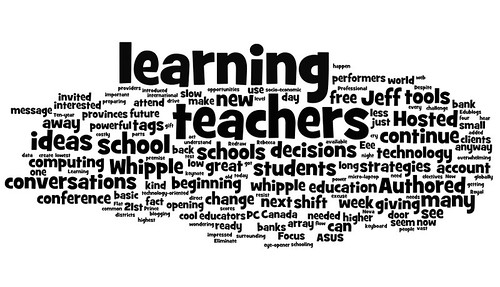
Wordle is one of them. This new tag cloud generator allows individuals to generate images that capture the essence of a piece of text, a website or a del.icio.us account. While it may seem rather silly, I believe that these new types of tools will become more important as a new information model defines the global community of the 21st century.

As a test, I sent my blog through the Wordle engine, and this popped out (click for a larger view). While a large smattering of terms fill the image, two primary words capture the center. The first is “learning”, reflecting my passion to shift education to reflect our young people.

The second, “teachers”, should also not be surprising. I want to point out the difference between “teachers” and “teaching”. I was happy to note that teaching didn’t even rate on the radar. This reflects a conscious effort to focus on moving the conversation from teaching to learning – to the point where I rarely discuss “teaching” strategies – or “teaching” anything else for that matter.

Now the questions becomes – could Wordle be an effective tool for learners in the education enterprise?

tags: technology, education, whipple, learning, wordle