Special thank-you’s mean so much…

I dropped by my boss’ office last week for a chat.  It was the end of the year and, while we keep in touch pretty much daily on twitter, it’s always good to have that f2f interaction.  We always seem to share ideas and frustrations, sharing our visions of learning.

As I sat down, I noticed a few laptops sitting in a carrying crate.  Our district has put together a few “loaner kits” of laptop pods for K-5 schools.  We also have loaners of GPS units for geocaching and podcast equipment.  While not the ideal of having ubiquotous access for all learners, it is a great start.  The units are in constant demand – a good problem to have – and the district continues to work to have more mobile kits available.

My boss was telling me about a recent visit he made to a Kindergarten class.  This young boy was eager to talk.  “Hey mister!  I wanna show you something…come over here!”.  My boss, of course, wanted to see what the youngster had created.  But it wasn’t a product that he wanted to show.  It was a secret.  The secret of the red line.

“See what happens when I don’t spell a word right”, he said.  “This little red line appears underneath it.  And look, if I right click, I get this word list and I have to choose the correct spelling for the word I want”.  My boss, of course, played along, pretending to have seen spellchecker for the very first time.

I know that many – including teachers I talk to – don’t like spellcheck.  They think it excuses kids from learning to spell.  I would argue that it does just the opposite.  If the red line didn’t appear under the word, he would never have known it was misspelled, and would never have had the opportunity to correct his spelling.
This child was becoming a 21st century learner.  Utilizing the available tools, he was able to identify and solve a problem.  This type of assistive technology will be increasingly available in their work, play and learning spaces.

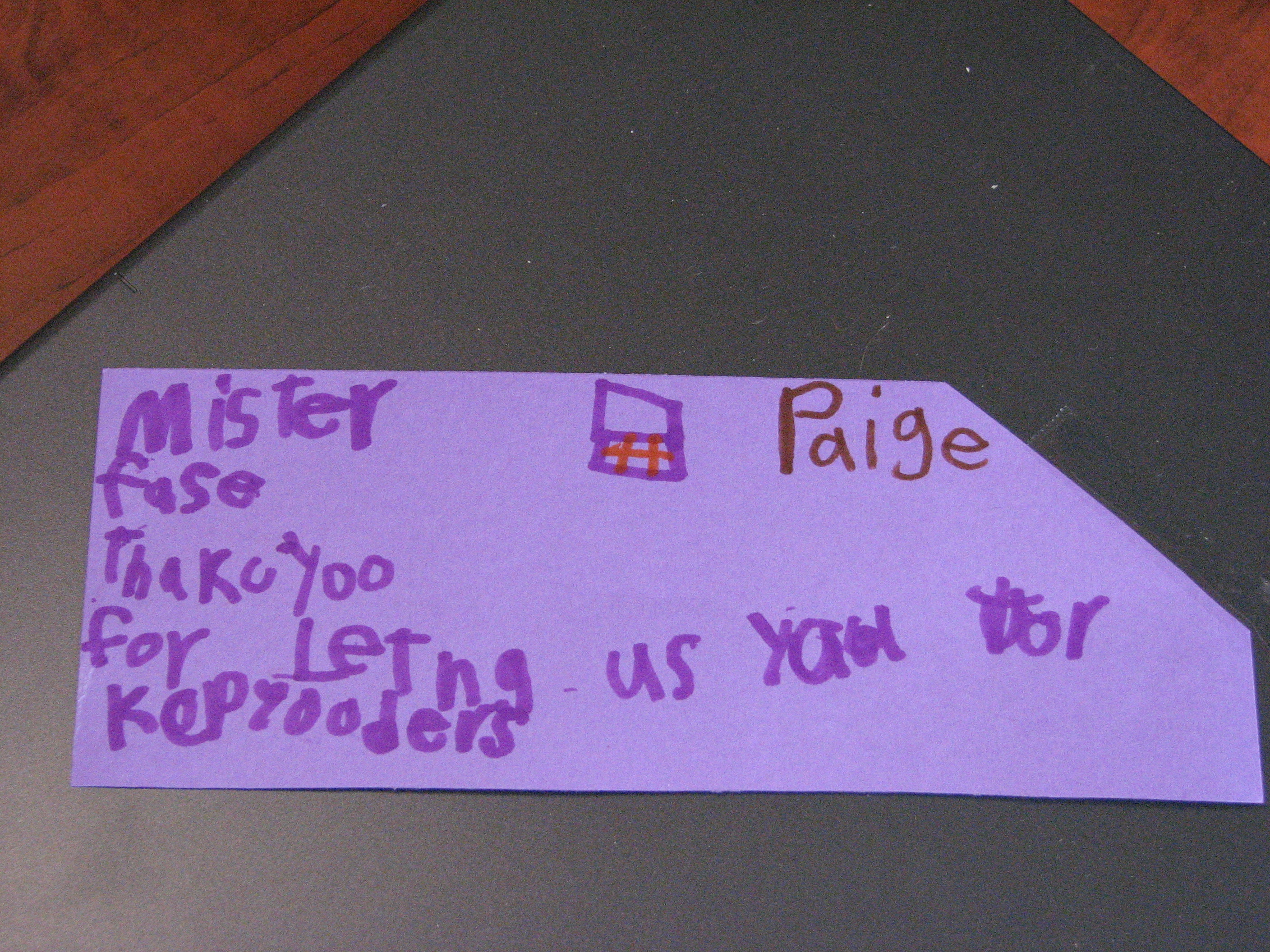
Of course, no loan would be complete without the thank-you note.  Coming from a kindergarten class, you would expect nothing less than perfection, misspellings and all!

Paige writes…“Mister Facey, Thank you for lending us your computers.”

What more could you ask for. Perfect.

tags: technology, education, whipple, learning

Can we go home again?

I was fortunate to grow up in a region more beautiful than any place I have ever visited (and I have been fortunate to travel a fair amount).  The Miramichi River region of northeastern New Brunswick in Canada is a generally rural area settled by the earliest European settlers to North America.  The strong Irish flavour of the area is evident in the English-dialect spoken by many of the people.  While I have generally lost the slang, it quickly comes back as soon as I cross the watershed line.  “How’s she goin’ by?”

Dependent on a natural resource based economy – particularly pulp and paper / forest products – the once booming area has struggled as of late, the victim of  increasing competition from cheaper producers in the developing world.  With highly developed transportation systems, the primary consumers from the US east coast simply find it more economical to source paper products from overseas.

I am home “on the river” this weekend.  My son is playing in a baseball tournament that has brought me home.  Simply put, a hectic lifestyle doesn’t give me enough opportunity to visit family here.  Friends aren’t much of a pull, as most of my high school chums have moved away to find opportunity.
Those that have stayed are mostly tradespeople,  doing the latest in a long-distance commute after the closing of the areas five mills, working in employee-hungry Alberta for 3 weeks and returning home for a week.  It’s certainly not the ideal – long times away from family are hard at both ends – but a choice most people live with in order to remain at home in the hopes that a miracle will happen and bring jobs back home.

Every time I come home –  and it will always be home – I have this urge to return permanently.  This time is no exception.  The river has this strange pull, even though there is little here economically.  I have a hard time placing my finger on it – maybe it’s the genuine nature of the people, maybe it’s the natural beauty of the area, maybe it’s the memories of salmon fishing as a youngster with my dad, maybe it’s the sense of community or maybe it’s a bit of all of that – but there is just something very special about the Miramichi.

Having said that, I am also excited about the opportunities to live globally.  My wife and I have been exploring discussions about taking a leave and spending some time living and working in Asia in the near future.  Is there a clash with these two tugs on the heart?

As educators, what does this flexibility in terms of opportunity mean for our students?  How many of them will be able to stay “at home”?  How many of them will choose to?  With the connected global community, how should the story of learning change to prepare our young people to work, play and learn in the world of the 21st century?

One thing is for certain, wherever I may live or visit – and I have now lived away from the river for over 20 years – the “Meer-ma-shee” will always be home.

tags: technology, education, whipple, miramichi, learning

Photo Credit: Rushhour Water Street, uploaded to Flickr on September 4, 2006 by tanker625

K12 Online Conference 08 – Call for Proposals

I love the connections available at f2f conferences.  The opportunity to build personal friendships and professional relationships are incredible PD, and can be leveraged in our classrooms through student-based collaborative projects.

Sometimes, however, it’s just not possible to get together.  Fortunately, in today’s digitally connected world, the opportunities can come to you.  This fall will see the third edition of the K12 Online Conference, a wonderful gathering of teachers, educators and learners who gather, both synchronously and asynchronously, do share, collaborate and learn.  You can find out more here, of by following the link to the right.

If you have something you are dying to share, the deadline for session proposals is next week.  It’s not to late to submit yours

“We are pleased to announce the call for proposals for the third annual “K12 Online Conference” for educators around the world interested in the use of web 2.0 tools in classrooms and professional practice. This year’s conference is scheduled for October 20-24 and October 27-31 of 2008, and will include a pre-conference keynote during the week of October 13. The conference theme for 2008 is “Amplifying Possibilities.” Participation in the conference (as in the past) is entirely free. Conference materials are published in English and available for worldwide distribution and use under a Creative Commons license. Some changes in the requirements for presentations are being made this year and are detailed below. The deadline for proposal submission is June 23, 2008. Selected presentations will be announced at NECC 2008 in San Antonio, Texas, USA on July 2.

tags: k12online, educationk12online08

Redefining SMART…

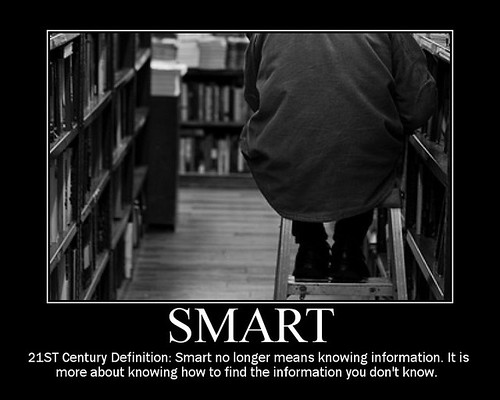
Caught this poster over on Cathy Nelson’s TechnoTuesday blog… it’s so simple it’s powerful.

This poster speaks volumes about the changing nature of our world. What does it mean for our schools? Just what to we need to be teaching our kids when all “knowledge” is a couple of mouse-clicks away?

I sent this out to our teachers today with a challenge. As we spend our last few days at schools this term, and move into summer renewal, take some time to reflect just what this should mean to us as teachers.

How should the increasingly connected nature of our global community – and our kids as individuals – be reflected in our schools? What should the shift in learning look like in their classroom?

I hope at least some of them take some time this summer to think about the massive shift needed in our schools to help our kids prepare for a connected and collaborative future in which they will work, play and learn – and what they can do to start shifting their individual classrooms.

tags: technology, education, whipple

Not on the Test

It’s been an interesting week of conversations with colleagues and parents about the place for standardized testing and it’s role in preparing our kids for their future in a globally connected world.

Well, it’s Friday, and a time for some levity…with a message of course.

I Came across this video for the song Not on the Test“, written by Tom Chapin and John Forster, and wanted to share it with you. The two wrote the song to express their disappointment in the lack of arts education in public schools. While we are lucky here in New Brunswick that, after years of neglect, music and art seem to be regaining importance in our schools, the growing demand for measuring teacher performance by high-stakes testing can do nothing but discourage teachers from innovation in developing connected and constructive, student-centered 21st century learning environments.

Enjoy.

tags: technology, education, whipple

Accountability by Scantron?

Education systems around the world are undergoing dramatic change – my province being no exception – as educational and community leaders (politicians) search for the magic pill that will transform learning to help prepare our kids for a future we can barely imagine.

I have been enthused by our new Minister of Education’s calls for teachers to be innovative and share their creative ideas. He has even put his money where it counts, with a $5 million Innovative Learning Fund from which educators and schools can draw resources to support innovative teaching methodology. The fund, while experiencing some initial growing pains, has been popular with teachers and has resulted in many new initiatives. The difficult part is how to assess the impact on learning of these initiatives. In other words, does the teacher get an F or an A?

Therein lies the rub. I have been rattling around the idea of assessment in my brain for a while now. Then came Clay Burrell’s latest post on the history of grading as a form of assessment. Seems like it traces back just over 200 years ago to a fellow named William Farish at Cambridge University who wanted to have an efficient method of increasing the number of students (and thus his profitability) that he could “teach” at any one time. This draws parallels to the concurrent wave of industrialization that was on-going at the time, where grading was also being implemented to assess product and, by extension, workers.

Of course, this practice quickly spread throughout educational institutions in the industrialized world, sending educational leaders into a frenzy of structure building. The measure of good teaching quickly became how well their students were able to “perform” on tests based on content. Critical thinking took a back seat to facts and figures.

Now, we even see schools closing due to poor test scores, even when it is widely recognized that there are so many other factors involved in the ability of a given set of students to achieve “success” on standardized tests than how they were taught. The same people demanding results also want teachers to prepare students for their future, not our past, and talk of innovation and a fundamental shift from teaching to learning. They appeal to teachers to nurture creativity and teamwork with our students, all the while demanding that teachers be accountable through the test. Luckily, we have been largely immune to this pass or perish mentality.

Daniel Pink, in his book A Whole New Mind, (it’s a must read if you haven’t already) documents a fundamental shift in the dominance of left-brain thinking to a world where creativity and connections will be the signature of success. So, the question begs, what does this have to do with traditional testing?

I can’t rationalize promoting creativity and innovation among teachers, yet holding the ability of their students to perform on standardized tests (the drawbacks of which are well-documented) as a measure of their success. Accountability simply cannot be held through a Scantron card.

I am all for accountability for teachers. I witness indifference to being a learner and unwillingness to change everyday. However, as soon as teachers are told that their success as an educator will be measured by their student’s performance on standardized tests, they will prepare their kids to take that test, to the detriment of REAL learning. We can’t have it both ways. If we truly want teachers to take the time to have their students drill deep, developing 21st century information literacy skills through authentic, project-based, collaborative activities, then assessment must assume a whole new meaning and role in the process.

One that does not include Scantron.

tags: technology, education, whipple, scantron

Photo Credit: Done Forever, Originally Uploaded to Flickr by mr. nightshade.

Dreaming of Shanghai…

As I have written before, I truly believe in the value of having teachers and other learning leaders connect. Part of that connecting can (must) be virtual, through blogs, twitter, ning et al, but I also know the power of the even more personal connection.

I have seen how it has affected my ideas about teaching and learning to have had the opportunity to attend a couple of events. This has also benefited my colleagues and the teachers at my school, as I have leveraged the personal and professional relationships that I have developed with people from around the world into powerful, student-based collaborative learning experiences.

Now comes this invitation from the folks at Learning 2.008 conference, scheduled for Shanghai in September.

Dear Jeff

We would like to inform you that you are invited to present at this years learning2.008 conference on “10 (not-so) Secrets About Wikis and Around the Corner – Across The Globe; Making Global Connections with Your Class

Please register at http://www.regonline.com/Checkin.asp?EventId=177180

Please use the unique presenter discount code xxxxxxxx to get your $50.00 discount

The Ning site is constantly being updated so please check it regularly.

If you have any questions or problems please contact us

The Presenter Team
Learning2.008
Simon and Steve

I have been talking to Jeff Utecht at Shanghai American School about this conference and other professional opportunities for a few months now. With the edustar-studded lineup (check out the website for details!) who have been invited as feature presenters and the visionary offerings from many of the primary participants from Asia, this conference has the potential to be THE event of the next year (including NECC).

On top of that, Asia is just such an exciting opportunity for our students. These are their workmates of the future. We need our students to be knowledgeable about the diverse cultural and geographic elements of this emerging regional giant in order to help them prepare to work, play and learn in the 21st century global community. The opportunities to leverage technology to connect our classrooms must not be missed.

The only problem is that it involves a significant outlay of cash (over $3000). Unfortunately, all potential funding sources seem to be running dry this year and, while I know how valuable these investments are to shifting the conversations and narratives about learning, with one kid just graduated from university last week, two kids in college and another just a couple years away, the whole shot just doesn’t fit into my family budget.

My boss agrees with the value of connection. His support in sending eight NMS staff to Memphis for the Laptop Institute in July speaks to his understanding about nurturing leadership and vision within our schools. The unfortunate part is that, even as we hit the 21st century – with all it’s challenges and opportunities – our system still hasn’t shifted to value the power of the global community as a learning environment and placed some resources in that vein.

We’ll see how my requests for support pan out.

tags: technology, education, whipple, learning2008

PicLens from Cool Iris

I usually don’t write about new tools that much, but this one is so cool I just had to share.

At our provincial year-end mentor meetings last week we had some time where individuals could share new tools and tricks. I tooks the opportunity to share Twitter – I’ll write more on that at some point – but one of the other mentors (can’t remember who right now) shared PicLens, a browser add-on from Cool Iris.

The add-on (I have only tried it on Firefox on my Mac, but it apparently works well on MSE and Safari on both platforms) allows a unique way to preview, search and view pictures from the web. The video says it all.

I had the opportunity today to try it on a SMARTBoard…wow! This has tremendous potential for collaborative sharing (it’ll work in flickr and photobucket) of class photosets and other web resources…and it’s visual appeal is attractive.

Oh yeah…like so much of the other cool stuff out there, it’s FREE!

tags: technology, education, whipple, piclens

Connected communities

I was doing my cyber-rounds today at lunch and dropped by CNN’s Tech section and saw the headline “City Unveils Huge Wireless Network“.  However, my initial excitement was quickly tempered when I read the article, which followed the implementation of a huge, multi-point wireless infrastructure which, unfortunately, was limited in use to public safety and other city staff.  Such a shame.

It would seem to me that we need to be approaching the point where wifi connectivity should be as basic as roads, sidewalks, learning and recreation facilities.  I am fortunate that my hometown of Fredericton, New Brunswick – a smallish city with a population of somewhere between 50 and 60 thousand on the east coast of Canada  – has taken up that charge.  Several years ago city council not only had the vision to utilize technology for municipal business, but also took the bold step to piggyback a FREE public wi-fi network, dubbed Fred-ezone, that covers most of the downtown core, the uptown shopping district, the airport and many other municipal facilities.

This means that I (or any resident/visitor to our town) can sit down at their favourite coffee shop, and connect away.  In this age of user produced content, community management and web-based apps, bandwidth remains the last obstacle to a democratic web, where all users are created equal.

I realize that Oklahoma City is significantly larger than Fredericton, but it would seem to me that with the infrastructure already in place, combined with higher density and economies of scale, it would benefit the city planners to open their web to public use.

The implementation of the free public wi-fi has resulted in tremendous exposure for Fredericton as a smart city – “Freddy” was recently recognized as among the top seven smartest cities in the world – and a tremendous economic advantage.

Having said all that, here’s the rub.  Our kids can go downtown and be connected via their cell phones and iPod Touch and whatever other wi-fi device they have, but most of these tools remain outside the learning processes within our schools.  Are we ready for open access learning?  Can we unlock the world for our kids?

tags: technology, education, whipple
, fredezone, fredericton

Social Media in Education

Many teachers and other adults from my generation have a hard time seeing any connection between the new media landscape and education. The reality is, however, all learning has evolved from conversations and connections over history, and the best learning is participatory in nature. While many cultures have no formal schooling, learning is integral to supporting the continued growth and health of their culture and communities.

Much of the challenge to shift adult thinking about social media in learning environments comes from misunderstanding. Perhaps this video will help. Can we draw correlations between the shift in new media and how we do business to the new tools and how we do learning?